

Bratislava’s Top Sights
Castles | Palaces | Churches | Streets
Our bucket list
Bratislava offers a range of notable sights that reflect its historical and cultural importance. While many key attractions are located in or around the Old Town and can be reached on foot, some, like Devin Castle, are situated further out and require a short trip. The mix of central landmarks and outlying sites gives visitors a well-rounded view of the city’s past and architectural diversity. This list includes the most visited and recognizable places in Bratislava, from castles and palaces to churches and historic streets. It’s designed to help visitors focus on the highlights, whether they’re exploring the city center or taking a short excursion beyond it. These sights represent the core of what makes Bratislava worth visiting.
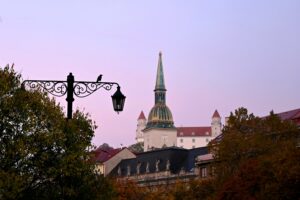
Perched on a hill where people have dwelled since the Stone Age and where the Celts minted their well-known Biatec coins, Bratislava Castle stands tall as the most impressive landmark in the city. For centuries, it was overseeing the intersection of Europe’s major trade routes – the Danube River and the Amber Road. Today, it exhibits a historical museum and a baroque garden. The castle walls and the castle park remain accessible at all times, offering one of the finest views of the city’s panorama.
Castle Hill, located at the confluence of the Danube and Morava Rivers, is one of Slovakia’s most significant archaeological sites. From prehistoric cultures, through the Roman and Germanic period, to the Slavs who built one of their earliest castles here, this site has witnessed continuous human settlement spanning thousands of years. The nearly thousand-year-old Devin Castle was destroyed by Napoleonic forces in 1809, but in the decades that followed, it became a symbol of Slovak national emancipation. During the Communist regime, the location gained notoriety as a perilous escape route to Austria. Today, the Gate of Freedom memorial, situated beneath the castle cliff, honors the memory of more than 400 people who were killed attempting to flee Czechoslovakia.
For centuries, the St. Martin’s Cathedral was playing a key religious and political role in Central Europe, as the coronation church of kings and queens of the Hungarian Kingdom, including famous Maria Theresa. The construction of this beautiful Gothic building was initiated in 1311 A.D. and finalized two centuries later. The 85-meter-high tower houses houses six bells, including a 2.5-ton Wederin, dating back to 1674, as well as a 150-kilogram golden-plated model of the Hungarian royal crown.
The longest operating church in Bratislava was consecrated on March 27, 1297 A.D. with the presence of king Andrew III. The monastery was attached to it during the 14th century. Through the 16th to 19th centuries, the Franciscan Church witnessed accolades of Knights of the Golden Spur by Hungarian kings coronated in Bratislava’s Saint Martin’s Cathedral. The complex includes architectural and artistic elements of the Gothic, Renaissance, Baroque and Classicist styles. The most beautiful masterpiece is represented by the 14th century marble statue of Pieta. The church and monastery are run by the Franciscan Order until these days.
Originally a Protestant church built in the early 17th century as a place of worship for German immigrants was transferred to the Roman-Catholic Jesuit Order after the suppression of a Protestant coup of 1672. When visiting the church, note the ornate wooden door, as well as the most precious artifact, the black gold-plated Rococo pulpit. Under the building, there is a large crypt that hides the remains of important members of the Jesuit Order who worked and died in Bratislava, including Cardinal Leopold Kolonic. The Holy Saviour Church is located right next to the Old Town Hall in the very center of the Old Town.
To commemorate the 700th anniversary of the birth of St. Elisabeth, the patron saint of Christian charity, a church dedicated to her was built in the early 20th century next to a new royal Catholic grammar school. This concrete temple was designed in the Vienna Secession style, the Austro-Hungarian interpretation of Art Nouveau, and adorned with tiny blue ceramic tiles that inspired its nickname, the Blue Church. The church’s altar houses relics of St. Elisabeth, along with remains of St. Clement the Roman, St. Vincent, and St. Theodora, making it a cherished spiritual and architectural landmark.
A beautiful complex of the Old Town Hall, built from the 14th to the early 20th centuries, showcases Gothic, Renaissance, Baroque, and Modern architectural styles. Since 1868, it has been housing the City Museum of Bratislava, making it the oldest museum in Slovakia. The permanent exhibition highlights the historic premises, decorations, and artifacts, guiding visitors through the city’s rich and fascinating history. Be sure to climb to the top of the medieval tower for a picturesque view of the Main Square, and don’t miss the wine cellars and the viticulture exhibition located in the adjacent Apponyi Palace.
This 18th century Rococo building has been hosting the Gallery of Bratislava since 1975. Its permanent exhibition installed on the first floor of the Mirbach Palace includes beautiful sacred paintings and sculptures, mostly representing Gothic and early Renaissance art. The oldest Medieval artifact, a wooden sculpture of madonna, probably dates back to the 13th century. The second floor features a selection of Central European Baroque art of the 18th century, including Franz Xaver Messerschmidt’s works Capuchin and Character Heads. The palace also houses a nice coffee shop, Emil.
This luxurious residence of the Primate, the Archbishop of Esztergom, was built in 1781 behind the Old Town Hall, on a square that once served as a meat market. In December 1805, the Peace of Pressburg (now Bratislava) was signed in the palace’s Mirror Hall, following the Battle of Austerlitz. The treaty, negotiated between Austria and France, led to the dissolution of the Holy Roman Empire and is commemorated through the Rue de Presbourg in Paris. The Primate’s Palace houses six exquisite English silk-and-wool tapestries from the 1630s, depicting the ancient tale of Hero and Leander, woven at the Royal Mortlake Tapestry Works. Its courtyard features a striking fountain of St. George battling the dragon.
The seat of the President, originally built in 1760 as the summer residence of Count Grassalkovich, is located just outside the Old Town’s pedestrian zone. While the Grassalkovich Palace is closed to the public due to its official function, the adjacent garden, featuring beautiful flower beds and old trees, remains open free of charge. Renowned for its beauty and tranquility, the garden is a popular spot for walks and relaxation.
Michael’s Gate is the only preserved gate from the medieval fortifications of Bratislava. It was built in the 13th century and served as a part of the city’s fortifications. The tower offers stunning views of the Old Town and is one of the most recognizable landmarks in Bratislava. Don’t miss out on the opportunity to snap a photo with this iconic gate! Besides the tower, be sure to visit the Red Crayfish, a small Museum of Pharmacy located within the Gate’s barbican.
During the Middle Ages, Bratislava’s massive City Walls played an important defensive role. The inner city was only accessible through three main fortified gates, and later a smaller one in the Danube direction. The Michael’s Gate featuring an iconic tower is the only one that survived until today. As the walls’ relevance decreased after the defeat of the Ottoman forces in the 18th century, their large part was destroyed to allow the city’s further expansion. Travel back in time by entering the preserved part of the walls through a bridge connecting it with the Castle Hill, a gate opposite to the St. Martin’s Cathedral, or a passage from Kapitulska Street. The Walls are open every day of the week.
Kapitulská Street is one of the oldest streets, predating the establishment of the city in the 13th century. It has long been home to Roman Catholic institutions, including the Faculty of Theology and Seminary, the Bishops’ Conference of Slovakia, a parish office, Premonstratensian nuns, a youth center, and Catholic radio and newspapers. This picturesque cobblestone-paved street, with its passages leading to the City Walls, remains one of the quietest and most romantic spots in the Old Town.
The Historical Building of the Slovak National Theatre, designed by Vienna-based architects in an eclectic style, first opened its doors in 1886 as a city theater. It became the home of the Slovak National Theatre upon its founding in 1920 and served this role throughout the 20th century. Currently, the building is not in use and awaits much-needed general reconstruction. Despite this, it remains a prominent feature of Hviezdoslav Square, graced by the beautiful fountain depicting the mythological tale of Ganymede.
The construction of this stunning eclectic building, blending elements of Baroque, Rococo, and Art Nouveau, was completed in 1919. After World War II, the Reduta was designated as the home of the Slovak Philharmonic, serving as its seat and main stage ever since. The large concert hall, with a capacity of 700 seats, showcases a magnificent Rieger pipe organ installed in 2011 during the building’s general reconstruction. Experience Bratislava through the timeless beauty of classical music performed by one of Europe’s finest philharmonic orchestras!
Bratislava features one of the world’s most unique bridges, housing an open-air observation deck and a fancy restaurant atop of its pylon, with a stunning view on the Bratislava Castle and the Old Town. Thanks to its futuristic flying-disc shape, it has become known as UFO.
Built in 1960, this memorial and military cemetery honors the soldiers of the Red Army who were killed in action in western Slovakia during World War II in April 1945. Despite its solemn purpose, Slavin is a favorite among locals and visitors for the stunning views it offers of Bratislava, particularly during the evening hours.
Explore more
Latest articles



Our lists
Go off the beaten path, discover hidden gems, extraordinary things to do, and personalize your vacation according to your preferences. Our carefully prepared lists and itineraries will help you navigate through available options and get most out of your stay in Bratislava.
What are the best vegan restaurants, burger places and clubs in Bratislava? How to plan the most romantic Christmas vacation? Where are the most beautiful city gardens and what adventures can you experience in Slovakia’s capital?
Let’s go beyond the usual tourist spots, and plan a truly unique visit!