
Main Square
Old Town Hall | Maximilian Fountain | Christmas Market
About
The square’s history dates back to 1373, when it was first mentioned in writing as Forum (the market). The current name, Hlavne namestie or Main Square, derives from the German Hauptplatz, first recorded in 1783. This change reflected the square’s evolving role—from a simple marketplace to a vibrant public gathering space central to city life.
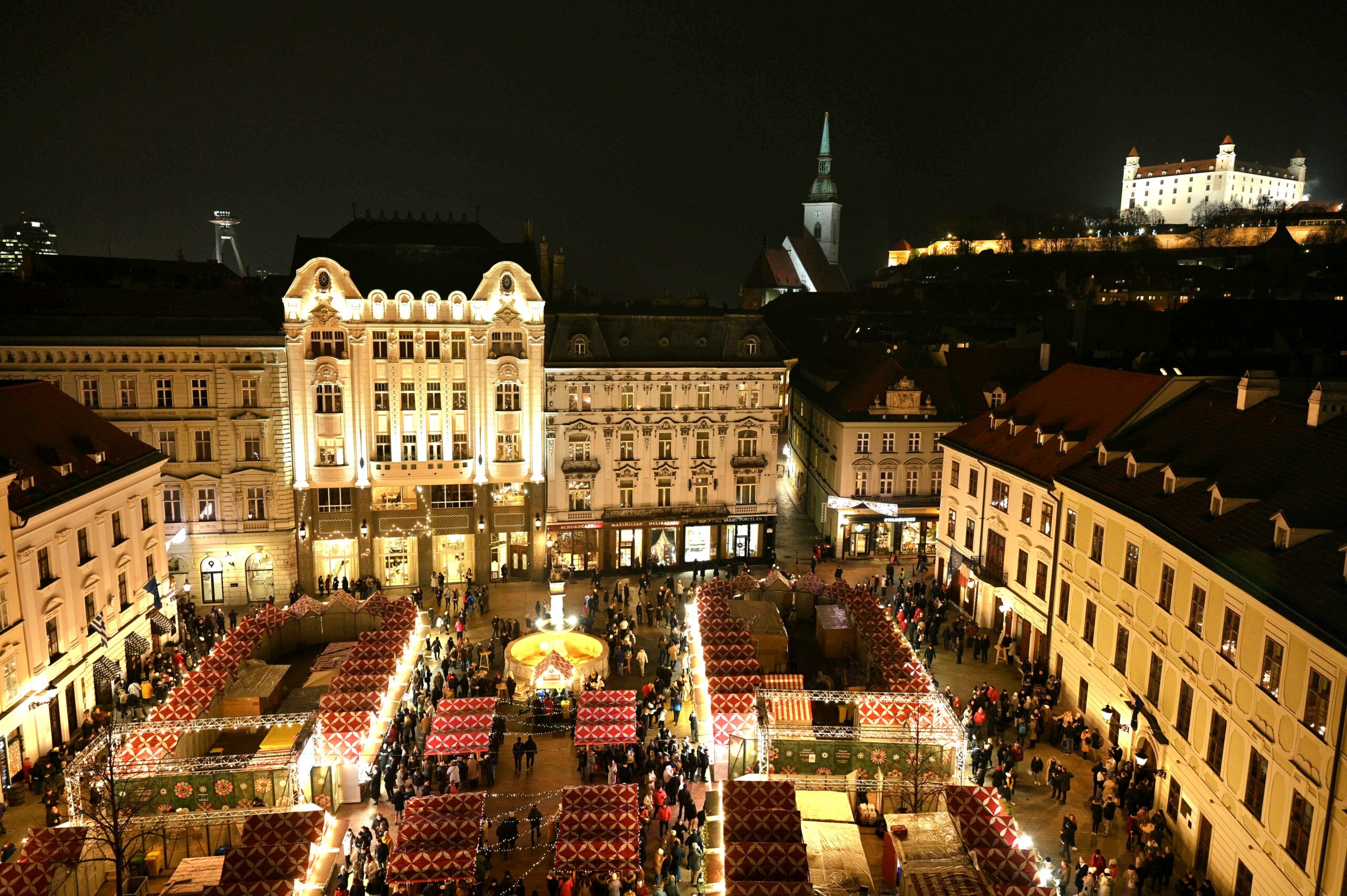
As the most important square in the medieval city, it is surrounded by historic houses with Gothic cores, some still featuring defensive towers. Today, these buildings host cafés, bars, and restaurants, as well as embassies and state institutions. Dominating the square is the tower of the Old Town Hall, which dates back to the 14th century. Adjacent to it is the Apponyi Palace, home to a medieval wine cellar and an exhibition showcasing Bratislava’s centuries-old winemaking tradition.
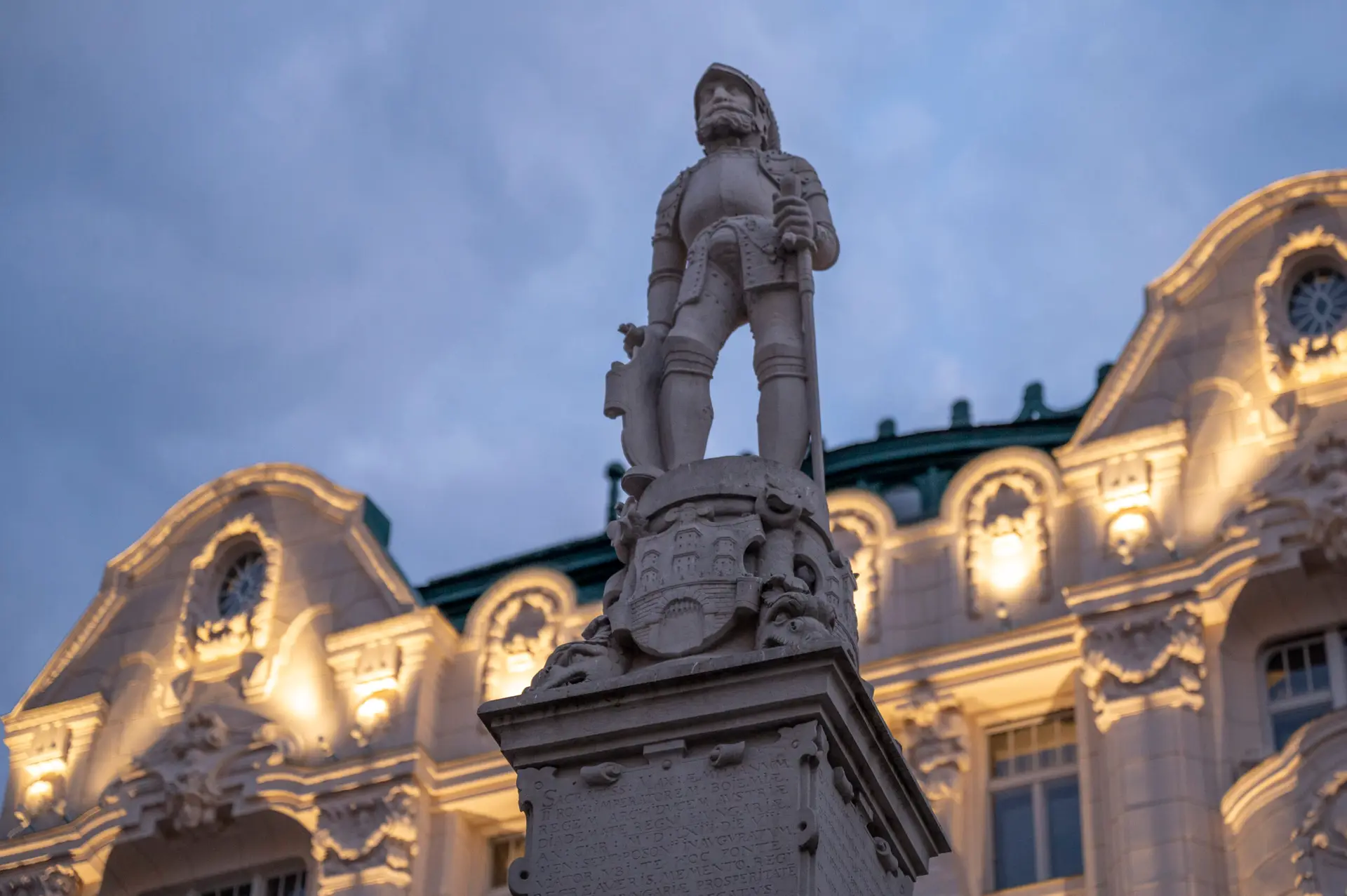
In the southwestern part of the square stands the Renaissance-Baroque Maximilian Fountain, also known as the Roland Fountain. Built in 1572 on the site of an old market well, the fountain was commissioned by Holy Roman Emperor Maximilian II, the first King of Hungary crowned in St. Martin’s Cathedral. The stone fountain, topped by a statue of Maximilian in armor, holding a sword and shield bearing the coat of arms of the Kingdom of Hungary, has undergone several restorations and remains one of the finest examples of its kind in Central Europe. Although some mistakenly believed the statue represented the mythical knight Roland, a common figure in European art, the fountain continues to be called the Roland Fountain.
Recent restorations have added new artworks that reflect the square’s rich history. A statue of a Napoleonic soldier commemorates the French bombardment of the city, traces of which include a cannonball lodged in the facade of the Old Town Hall’s tower. Nearby, by the entrance to Café Mayer, stands a statue of Schone Naci, a beloved early-20th-century figure of the Old Town promenade known for his elegant yet humble demeanor.
The Main Square regularly hosts cultural events, but its charm is most evident during Advent when it transforms into one of Europe’s most picturesque Christmas Market, a haven for Instagram-worthy photos.
Logistics
- Hlavné námestie, Bratislava
- Non-stop
- Free of charge
- Look at the picturesque square from above. Visit the Old Town Hall's tower.
Tips
Nearby restaurants
The streets of Bratislava’s Old Town are filled with coffee shops, bars, and restaurants to suit every taste. On Laurinská Street near the Nedbalka Gallery, you’ll find the quality Thai restaurant SOHO, the informal and relaxed Urban House, and the popular coffee shop Mondieu. From the Main Square, you can visit the Dubliner Irish Pub or the Barrock Pub on Sedlárska Street, or explore the numerous options on Panská Street and Hviezdoslav Square. For traditional Slovak cuisine, head to the Flagship Restaurant on SNP Square, just outside the pedestrian zone, or indulge in festive treats at the Christmas Market, held every December on the Main Square and Hviezdoslav Square. If you’re looking to slow down and unwind, step into the Mirbach Palace, where you’ll find Emil, a delightful coffee shop with seating options both indoors and in a charming, cozy atrium.
Things to do nearby
This is the heart of the city, with all Old Town attractions within easy reach. In the square’s eastern vicinity, discover the Old Town Hall, Primate’s Palace, Old Markethall, and the exquisite modern Nedbalka Gallery. To the north, explore the Jesuit Church, Franciscan Monastery, Mirbach Palace, and Michael’s Gate. When ready, head west to St. Martin’s Cathedral or south to the Danube, where you can unwind and dine on Hviezdoslav Square.
A beautiful complex of the Old Town Hall, built from the 14th to the early 20th centuries, showcases Gothic, Renaissance, Baroque, and Modern architectural styles. Since 1868, it has been housing the City Museum of Bratislava, making it the oldest museum in Slovakia. The permanent exhibition highlights the historic premises, decorations, and artifacts, guiding visitors through the city’s rich and fascinating history. Be sure to climb to the top of the medieval tower for a picturesque view of the Main Square, and don’t miss the wine cellars and the viticulture exhibition located in the adjacent Apponyi Palace.
This Rococo palace, complete with a medieval wine cellar, serves as the Museum of Viticulture and offers quality wine tastings. Explore the museum to discover Bratislava’s rich wine-growing and winemaking heritage, which dates back to the 3rd century and flourished further from the 13th century onward. The museum, located in the Apponyi Palace, is connected to the museum in the Old Town Hall, where combined tickets are available for purchase. The underground rooms house the Slovak National Collection of Wines, a commercial wine-tasting establishment.
This 18th century Rococo building has been hosting the Gallery of Bratislava since 1975. Its permanent exhibition installed on the first floor of the Mirbach Palace includes beautiful sacred paintings and sculptures, mostly representing Gothic and early Renaissance art. The oldest Medieval artifact, a wooden sculpture of madonna, probably dates back to the 13th century. The second floor features a selection of Central European Baroque art of the 18th century, including Franz Xaver Messerschmidt’s works Capuchin and Character Heads. The palace also houses a nice coffee shop, Emil.
The longest operating church in Bratislava was consecrated on March 27, 1297 A.D. with the presence of king Andrew III. The monastery was attached to it during the 14th century. Through the 16th to 19th centuries, the Franciscan Church witnessed accolades of Knights of the Golden Spur by Hungarian kings coronated in Bratislava’s Saint Martin’s Cathedral. The complex includes architectural and artistic elements of the Gothic, Renaissance, Baroque and Classicist styles. The most beautiful masterpiece is represented by the 14th century marble statue of Pieta. The church and monastery are run by the Franciscan Order until these days.
Originally a Protestant church built in the early 17th century as a place of worship for German immigrants was transferred to the Roman-Catholic Jesuit Order after the suppression of a Protestant coup of 1672. When visiting the church, note the ornate wooden door, as well as the most precious artifact, the black gold-plated Rococo pulpit. Under the building, there is a large crypt that hides the remains of important members of the Jesuit Order who worked and died in Bratislava, including Cardinal Leopold Kolonic. The Holy Saviour Church is located right next to the Old Town Hall in the very center of the Old Town.
This luxurious residence of the Primate, the Archbishop of Esztergom, was built in 1781 behind the Old Town Hall, on a square that once served as a meat market. In December 1805, the Peace of Pressburg (now Bratislava) was signed in the palace’s Mirror Hall, following the Battle of Austerlitz. The treaty, negotiated between Austria and France, led to the dissolution of the Holy Roman Empire and is commemorated through the Rue de Presbourg in Paris. The Primate’s Palace houses six exquisite English silk-and-wool tapestries from the 1630s, depicting the ancient tale of Hero and Leander, woven at the Royal Mortlake Tapestry Works. Its courtyard features a striking fountain of St. George battling the dragon.
A small private gallery showcasing the works of Slovakia’s finest painters and sculptors from the late 19th century to the present day. Situated on Nedbalova Street, between the Primate’s Palace and the Old Market Hall, it offers the perfect opportunity to slow down and appreciate modern art. The experience is further enhanced by the building itself—a stunning cultural monument with four levels of galleries encircling a central open space.
A small bronze sculpture of an ordinary man happily observing daily life on Korzo, Bratislava’s promenade zone, was installed in 1997. Alongside the statues of Schone Naci and the Napoleonic Soldier located in the Main Square, Cumil (the Gazer) is one of the most photographed tourist attractions in Bratislava. To set the record straight, Cumil does not represent a water company worker or a soldier, the cap is not a helmet, and there is no evidence that touching the statue will bring you happiness.